
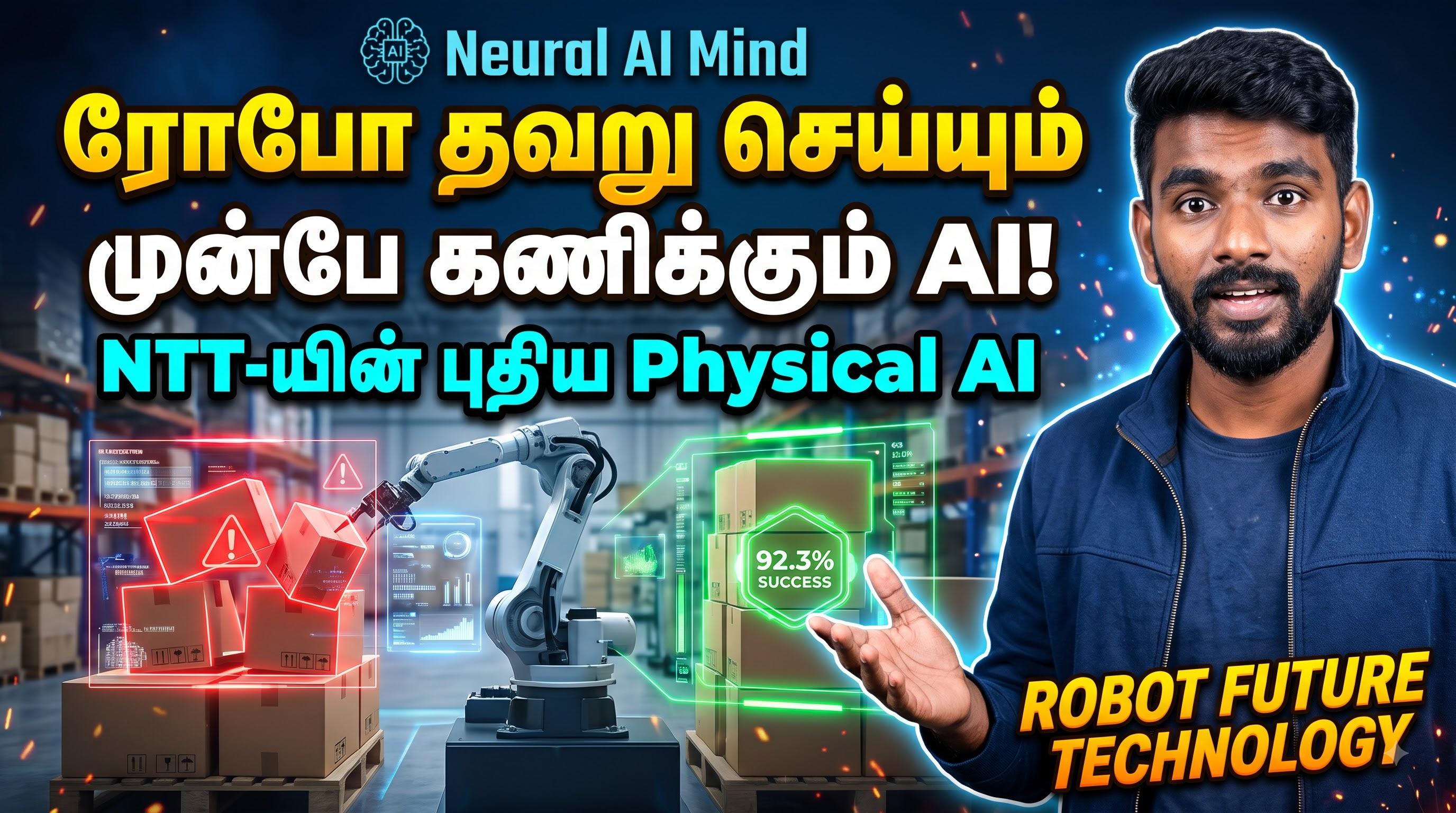
What if a robot could predict that a suitcase might fall before it even tries to lift or move it?
On November 11, 2026, Japanese telecommunications and technology company NTT announced a new Physical AI technology designed to help robots predict the outcomes of their possible actions before executing them.
The system focuses on situations such as stacking boxes, handling parcels and loading airport baggage, where objects have different shapes, weights and orientations.
What is NTT's new Physical AI technology?
NTT has developed a World Model that evaluates possible robot actions and predicts whether they could cause objects to fall or loads to collapse.
Instead of immediately performing an action, the system considers multiple possible movements and evaluates their likely outcomes. It can then help the robot's control system choose an action that is more likely to succeed.
How does the World Model work?
The technology combines a video-generation model with a proprietary component called a Physics Control Adapter.
The system estimates physical properties such as:
- Object position
- Orientation
- Velocity
- Mass
It uses these properties and equations of motion to predict how objects may move after a robot performs an action.
For example, a robot stacking luggage may consider several ways to place a suitcase. The World Model predicts which option could make the stack unstable and helps select a safer movement.
What is a World Model in AI?
A World Model is an AI system that represents its surroundings and predicts how those surroundings may change after an action.
A conventional chatbot mainly processes information and generates responses. A World Model is intended to predict changes in an environment, which is especially useful for robots that must interact with physical objects.
This is an important area of Physical AI, where artificial intelligence is connected to machines that perceive and act in the real world.
NTT's reported experiment: 92.3% success rate
NTT reported a shelf-loading experiment using a small robot to simulate stacking objects.
The company reported:
- Without the technology: 73.1% task success
- With the technology: 92.3% task success
These figures come from NTT's own announcement and refer to a specific experiment. They should not be interpreted as a guaranteed success rate for all robots or commercial warehouse operations.
Where could this technology be used?
NTT identifies airport baggage handling as an initial application area.
Potential uses include:
- Airports: Handling suitcases with different sizes and weights.
- Warehouses: Stacking and moving parcels.
- Manufacturing: Handling components and materials.
- Logistics: Improving the reliability of automated loading and unloading.
- Retail: Handling different products in automated environments.
NTT says it plans to advance field trials in collaboration with robotics company Mujin.
What are the limitations?
The technology is still at a development and testing stage. A model's prediction can be incorrect, especially when sensors provide incomplete information or an environment changes unexpectedly.
Real-world deployment requires reliable sensors, safe robot-control systems, extensive testing and monitoring. The reported shelf-loading result has not been independently replicated in the sources reviewed for this article.
Conclusion
NTT's announcement illustrates an important direction in robotics: AI that does not simply decide what action to take, but first predicts what might happen after that action.
If this approach proves reliable in real operating environments, it could help robots handle unpredictable objects more safely in airports, warehouses and factories.
The important development is not that robots can predict the future perfectly. It is that AI is increasingly being designed to help machines evaluate possible outcomes before acting.
Sources
- NTT official announcement, November 11, 2026: https://group.ntt/en/newsrelease/2026/11/11/261111b.html
- AI Watch coverage: https://ai.watch.impress.co.jp/docs/news/2155156.html
- NTT R&D Forum 2026: https://www.rd.ntt/e/forum/2026/
- Mujin: https://www.mujin-corp.com/
Research checked: November 13, 2026. Experimental performance figures are attributed to NTT.
